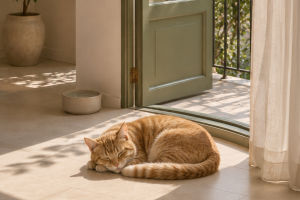
You've probably watched your cat or some other cat stretch, yawn, and flop back down for the fourth nap of the day and wondered if anything is actually wrong.
Nothing is wrong. A healthy grown cat sleeps somewhere between 12 and 16 hours out of every 24, and some kittens and older cats push past 20 hours.
The hunter that never hunts
Your cat's body is built for short bursts of intense activity followed by long recovery. A wild cat chasing prey sprints for a few seconds, then rests for hours. House cats kept the same wiring but lost the chase. So the rest period stayed, and the sprint mostly disappeared. That's why your cat can sleep through an entire afternoon and still wake up ready to attack a shoelace at full speed.
Sleep comes in two flavors
Cats cycle through deep sleep and a lighter phase called REM, same as you do. The difference is speed. A cat can drop into deep sleep within minutes, and the cycles run shorter, roughly 20 to 30 minutes each. Watch your cat's paws twitch and whiskers move during REM sleep, and you're seeing the phase when dreams happen. They also doze in a half-awake state with ears still tracking sound, which is why a bag crinkle wakes them instantly.
Timing follows the hunt
Cats are crepuscular, most active around dawn and dusk. That schedule made sense when prey moved during those hours. Indoor life didn't rewrite it. So your cat sleeps hard through midday and gets a second wind around the time you want to relax. If yours keeps you up at 3 a.m., the fix is usually more play before bed, not less sleep during the day. A 10-minute session with a wand toy that ends in a real catch can shift the whole pattern within a week.
When extra sleep means something
More sleep isn't automatically a problem. But a sudden jump in hours, especially when paired with hiding, skipping meals, or losing interest in play, is worth a call to the vet. Cats are good at masking discomfort, and sleeping more is one of the few signals they give. Track it for a few days before you decide. A cat that sleeps 18 hours but still greets you at the door and eats normally is probably fine.
Give them a good place to land
Where a cat sleeps matters as much as how long. They pick spots that are warm, elevated, and slightly enclosed. A windowsill in afternoon sun, a cardboard box, a shelf above the couch. You can work with that. Put a soft bed near a heat source and a high perch where your cat can watch the room. Rotate the spots every couple of weeks so the novelty keeps them interested.
So the next time your cat snoozes through your favorite show, don't read it as boredom or a health scare. It's a 12- to 16-hour rest cycle, doing exactly what it was built to do. Watch when your cat wakes up, and you'll learn more about its real rhythm than any chart can.