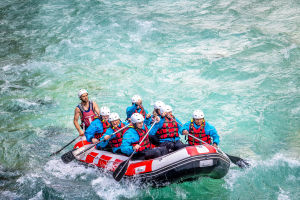
At first glance, whitewater rafting looks like a sport driven by strength and courage. In reality, the biggest advantage belongs to the crew that understands the river.
Experienced guides spend far more time reading currents than fighting them. Once you know what to look for, a rapid looks less like random foam and more like a map full of useful clues, and every member of the crew can paddle with more control.
Read the River Before You Paddle
Most first-time rafters watch the water directly in front of the raft, while experienced guides look much farther ahead. One of the first features they identify is the main downstream flow, often called the tongue. It usually appears smoother than the surrounding whitewater and often forms a broad V-shaped channel pointing downstream.
While the tongue isn't automatically the safest route, it frequently shows where the strongest current is moving. Guides also scan for standing waves, exposed rocks, narrow channels, and eddies, the quieter areas where water circulates behind obstacles.
These calmer pockets let a crew slow down, regroup, or prepare for the next rapid. The best decisions are usually made several seconds before the raft reaches it.
Choose the Right Route, Not the Hardest One
A common misconception is that bigger waves always make for a better rafting experience. Guides rarely aim for the roughest water simply because it looks exciting. Instead, they choose a route that balances flow, maneuverability, and safety.
Commercial rafting sections commonly range from Class II to Class IV on the whitewater difficulty scale, depending on the river and current conditions. Beginners often enjoy Class II or easier Class III sections, where waves are exciting without demanding advanced technical skills. More challenging stretches require faster reactions and much more precise boat control.
River levels also matter. After rainfall or snowmelt, familiar routes can change dramatically as stronger currents reshape individual rapids.
Follow the Guide's Calls
Many newcomers think rafting is about paddling as hard as possible, but timing matters more than strength. A guide may call "forward" for only a few pulls of the paddle before suddenly asking everyone to stop. That isn't hesitation, it's strategy.
Sometimes the current itself provides enough speed, and extra paddling could push the raft off the intended line. In other situations, a short burst of synchronized paddling is all that's needed to avoid a rock or cross an eddy line, the boundary between the main current and an eddy.
If eight paddlers pull together, the raft responds smoothly. If everyone reacts at different moments, steering becomes much less precise.
Three Questions to Ask Your Guide
Different sections of the same river can feel surprisingly different, and conditions change from day to day. Before getting into the raft, it helps to ask three practical questions:
1. What whitewater class is this section expected to reach under today's conditions?
2. Which rapids need the most precise paddling, and what calls should we expect there?
3. Approximately how much active paddling is expected from each person in the raft?
The answers tell you what the water will demand and help the whole crew react faster when a rapid begins.
Don't Let the Water Fool You
On clear mountain rivers, rocks below the surface often appear closer than they actually are, while moving water can seem calmer than its true speed. This visual illusion catches many beginners by surprise.
Water clarity tells you very little about current strength, and a smooth-looking channel may still carry water downstream remarkably quickly. Judging flow by the movement of foam, floating leaves, or small ripples is usually more reliable than relying on color alone.
Small Habits Make a Big Difference
Success in rafting often comes from avoiding simple mistakes rather than making spectacular moves. Experienced crews develop three habits. They keep watching downstream instead of focusing only on the bow of the raft. They listen for the next command before finishing the previous one.
They also hold their paddle ready even during calmer sections, knowing the river can change within seconds. None of these actions requires exceptional fitness, but together they make a crew more responsive when conditions become technical.
Rapids are not random obstacles: they follow patterns that get easier to recognize with practice. On your next trip, ask the guide to point out the tongue and the eddies before each rapid, then try to spot them yourself on the next one.